Orville's Ornithopters
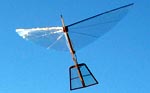
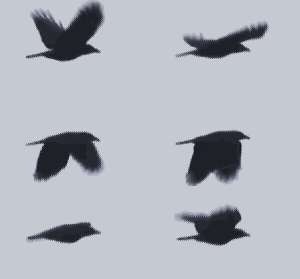
Humans have wanted to fly for thousands of years. They looked at birds, bats, and insects flitting effortlessly over the landscape, and they wanted to try it too. It was natural that people first tried mimicking the way these creatures fly, and tried to construct machines with wings that flap. But this kind of device is actually more complex than a simple airplane or helicopter, and their ideas never got off the ground. |
 |
|||
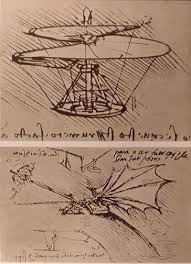 |
Even Leonardo daVinci, the Renaissance genius, tried his hand at designing a flying machine. But as far as anyone knows, nobody ever succeeded in getting it to work. | |||
Why "Ornithopter"?An ornithologist is one who studies birds. This word comes from the Greek word for bird, ornithos, + -ology, which is used to denote a subject of study or interest. The word "helicopter" comes from combining the Greek words for spiral and wing, helix + pteron. So it was logical to name this flying machine the Ornithopter, from the Greek words for bird and wing, ornithos + pteron. |
Design AdvantagesFlapping wings actually provide advantages over the fixed-wing and rotary designs of airplanes and helicopters. One of the biggest advantages is maneuverability. If the wing is designed with the flexibility to mimic the muscles and tendons of birds, then the ornithopter can perform the same sort of intricate flying maneuvers we see birds and bats doing. Modern technology has made precise steering possible, with the aid of on-board flight computers which use nanotechnology to direct the mechanical "muscles and tendons" which control steering and speed. This software uses a steady-state linear evolutionary algorithm, through which it has the capability to learn how to fly better, the more it flies. Patented technology by Orville's Ornithopters™ allows you to control the ornithopter by merely thinking about flying. Similar to an EEG, electrodes applied to precise locations on the scalp sense your thoughts and use fine-tuned neural oscillations in a Laplacian montage through a differential amplifier to direct the high-performance servos and other precision components that make up the wing apparatus. |
|||
Now You Can Own One Yourself!The latest scientific advances have now made it possible for you to fly in your own personal aircraft! See our Products page for more info. |
||||